
Why your listing agent isn't your best friend when buying
The Difference Between a Buyer Agent vs Listing Agent — And Why It Matters in Los Angeles

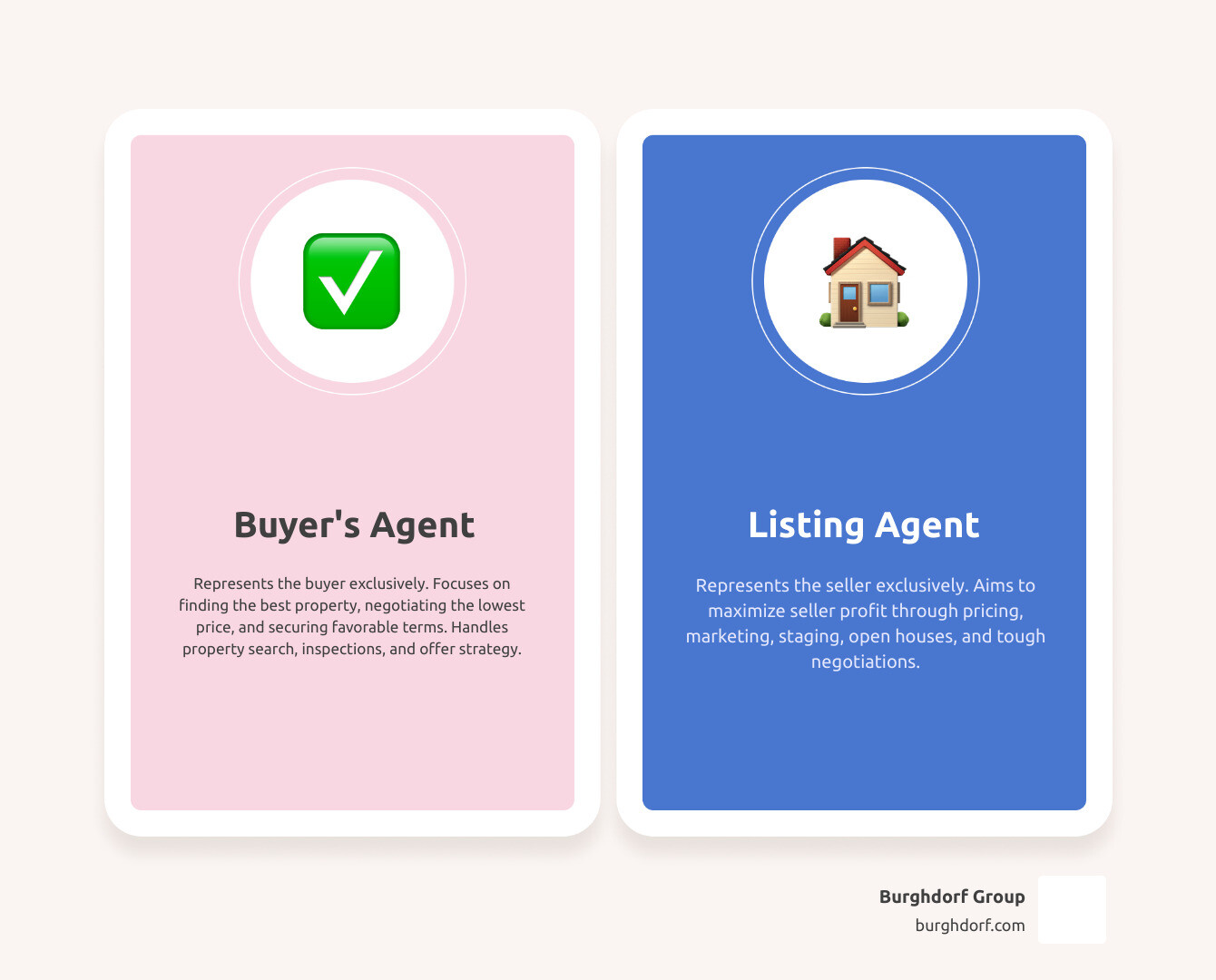
A buyer agent vs listing agent are two distinct roles with opposing loyalties in any real estate transaction. Here is a quick breakdown:
| Buyer's Agent | Listing Agent | |
|---|---|---|
| Who they represent | The buyer | The seller |
| Primary goal | Get you the best price and terms | Get the seller top dollar |
| Who hires them | The buyer | The seller |
| Fiduciary duty | To the buyer | To the seller |
| Key tasks | Property search, offer strategy, inspections | Pricing, marketing, negotiations for seller |
These are not interchangeable roles. They serve opposite sides of the same deal.
This distinction is easy to miss — especially in a competitive market like Los Angeles, where the pressure to move fast can push buyers into working with whoever is standing at the open house door. That agent at the door? They work for the seller.
According to the National Association of Realtors, 89% of home buyers use a real estate agent to navigate the buying process. But not all representation is equal. Walking into a transaction without your own dedicated advocate — particularly on a multi-million dollar Westside property — can cost you far more than you realize.
I'm Lolita Burghdorf, and with nearly two decades of experience guiding buyers and sellers across Los Angeles's most competitive luxury markets, I've seen how misunderstanding the buyer agent vs listing agent distinction leads to costly mistakes. In this guide, I'll walk you through exactly what each role means, where the conflicts lie, and how to protect your interests.
Defining the Roles: Buyer Agent vs Listing Agent
To navigate the Los Angeles real estate market in 2026, you first have to understand who is sitting at the table. While both professionals are licensed real estate agents, their job descriptions are mirror images of one another.
A listing agent (also known as a seller's agent) is hired by a homeowner to market and sell their property. Their loyalty is bound by contract to the seller. On the other side, a buyer's agent is hired by you, the purchaser, to find the right home and ensure you don't overpay.
The confusion often stems from the fact that both agents share the same goal: a closed sale. However, the path they take to get there is very different. For a deeper dive into these technical distinctions, you can explore The Difference Between a Listing Agent and a Selling Agent.
Primary Responsibilities of a Listing Agent
When we represent a seller in Brentwood or Pacific Palisades, our primary focus is the property itself. The listing agent's world revolves around:
- Pricing Accuracy: Using a Comparative Market Analysis (CMA) to ensure the home is priced to attract multiple offers without leaving money on the table.
- Marketing Excellence: Organizing professional photography, 3D virtual tours, and high-end staging to make the home look its absolute best.
- MLS Management: Ensuring the property is accurately represented on the Multiple Listing Service and major portals like Zillow.
- Open Houses: Hosting events to draw in as many qualified buyers as possible.
- Negotiating for Top Dollar: Vetting buyers for pre-approval letters and playing multiple offers against each other to drive the price up.
A listing agent can often handle 30 to 50 listings at once because their work is property-centric. They are the "marketing department" for the home.
What a Buyer Agent vs Listing Agent Does for You
If the listing agent is the marketing department, the buyer's agent is your personal advocate and private investigator. When comparing a buyer agent vs listing agent, the buyer's representative focuses on your needs, not the house's needs.
Their responsibilities include:
- Property Matching: Digging through the MLS and their own professional networks to find homes that fit your criteria — including "pocket listings" that haven't hit the public market yet.
- Identifying Red Flags: An expert agent can spot structural issues, unpermitted additions, or neighborhood trends that might affect future resale value.
- Offer Structuring: In 2026, a "clean" offer is often more important than the highest price. We help you minimize contingencies and use tools like escalation clauses to win bidding wars.
- Coordination: Managing the "moving parts" — from home inspections and sewer scopes to appraisals and mortgage underwriting.
For a comprehensive look at these duties, check out Real Estate Agent: Buying Agents Vs. Listing Agents.
Why the Listing Agent’s Loyalty Lies with the Seller
It is a common scenario: You see a beautiful home in Santa Monica with a yard sign, and you call the number on it. The agent who answers is friendly, knowledgeable, and offers to show you the house. It feels convenient, right?
But here is the catch: That agent has already signed an exclusive listing agreement with the homeowner. They have a legal and ethical "fiduciary duty" to that seller. This duty includes:
- Confidentiality: They cannot tell you if the seller is divorcing and desperate to sell.
- Loyalty: They must act in the seller's best interest, which means getting the highest price possible.
- Disclosure: Anything you tell them — like "we are willing to go $50k higher" — must be reported back to the seller.
When you work with the listing agent, you are essentially asking your opponent's coach to help you win the game. This is why Navigating the Real Estate Maze: A Guide to Finding the Best Realtor in Santa Monica emphasizes having your own representation from the start.

The Conflict of Interest in Dual Agency
Dual agency occurs when one agent (or two agents within the same brokerage) represents both the buyer and the seller in the same transaction. In California, this is legal as long as there is written, informed consent from both parties. However, just because it’s legal doesn't mean it’s a good idea.
In a dual agency scenario, the agent becomes a "neutral facilitator" or transaction broker. They can no longer advocate for either side. They can't suggest a lower price to you, and they can't suggest a higher price to the seller. They are essentially a glorified paperwork processor.
Because of this inherent conflict of interest, dual agency is actually illegal in eight states, including Florida and Colorado. Even in Los Angeles, many consumer advocacy groups discourage it because it compromises the agent's ability to provide undivided loyalty. You can learn more about these risks in Should You Use the Listing Agent When Purchasing a Home?.
Why You Need Your Own Buyer Agent vs Listing Agent Representation
Having your own agent provides a layer of protection that the listing agent simply cannot offer.
- Emotional Distance: Buying a home is emotional. We act as a buffer, preventing you from making reactive decisions that could cost you money.
- Independent Market Analysis: We don't care what the "asking price" is; we care what the "fair market value" is. We provide data on what comparable homes in Encino or Calabasas actually sold for.
- Repair Credits: If an inspection reveals a faulty roof, your agent will fight for a repair credit. A listing agent’s goal is to minimize those credits to keep the seller’s proceeds high.
- Contractual Protection: We ensure all deadlines are met and that your earnest money deposit is protected throughout the escrow process.
As noted in Buyer's Agent vs. Listing Agent: Differences and Duties | National Residential Authority, the peace of mind that comes with dedicated advocacy is invaluable.
How to Navigate Commissions and the NAR Settlement in 2026
The landscape of real estate changed significantly following the National Association of Realtors (NAR) commission settlement in August 2024. As of April 2026, these changes are the new standard for every transaction in Los Angeles.
The most important change for you to know is that buyer's agents must now execute a written compensation agreement with their clients before showing any homes. This means you will have a transparent conversation about fees and services before you even step foot in a Brentwood mansion.
Commissions have always been negotiable, but the 2026 market is more transparent than ever. For a detailed breakdown of these industry shifts, read What is a buyer’s agent? Key benefits and considerations.
Who Pays the Buyer Agent vs Listing Agent Fees?
Historically, the seller paid the total commission (often 5% to 6%), which was then split between the listing brokerage and the buyer's brokerage. In 2026, while many sellers still offer "concessions" to cover the buyer's agent's fee to attract more offers, it is no longer a guarantee.
Here is how it typically works now:
- Seller-Paid Concessions: The seller agrees to pay your agent's fee out of their proceeds. This remains common in competitive markets like Sherman Oaks and Venice.
- Buyer-Paid Fees: In some cases, you may agree to pay your agent's commission directly, or the fee may be factored into your offer as a closing credit.
- Transparency: Your written agreement will specify exactly what your agent is owed. If a seller is only offering 2% but your agreement is for 2.5%, you and your agent will discuss how to bridge that gap before making an offer.
Understanding these costs is a key part of How to Select the Best Real Estate Agent in Los Angeles.
Steps to Choosing the Right Representation in Los Angeles
Los Angeles isn't just one market; it’s a collection of hyper-local micro-markets. A strategy that works in the Hollywood Hills might fail miserably in Malibu. That’s why choosing an agent with local expertise is the most important decision you'll make.
When interviewing agents, look for the Accredited Buyer’s Representative (ABR) designation. This indicates they have undergone specialized training to advocate specifically for buyers. You can see how this expertise makes a difference in our guide, Unlocking Your Dream Home: Why Brent and Lolita Stand Out as the Best Realtors in Beverly Hills.
Vetting a Buyer Agent vs Listing Agent for Local Expertise
To win in 2026, you need more than someone who can open a lockbox. You need "block-to-block" knowledge.
- Pocket Listings: About 18% of high-end transactions in Santa Monica and Pacific Palisades in early 2026 occurred off-market. Does your agent have the network to find these?
- Referrals: 40% of buyers find their agent via a referral. Ask for recent client testimonials from the specific neighborhood you're targeting.
- Communication Style: In a market where a Los Feliz listing can get 4 offers in 3 hours, you need an agent who responds to texts and calls instantly.
- Neighborhood Nuances: In Venice, a home on one side of a boulevard can carry a 12% price premium over one just two blocks away. Your agent should know why.
For more tips on finding a local specialist, see our post on Venice Real Estate Agents.
Frequently Asked Questions about Agent Roles
Can I work directly with the listing agent to save money?
It’s a tempting thought. If the seller doesn't have to pay a second agent, maybe they'll lower the price for you? In reality, this rarely happens. Most listing agents have an agreement where they keep the full commission if the buyer is unrepresented (a practice called "double-ending"). Even if they do reduce the fee, you lose your advocate. You risk overpaying for the home or missing significant red flags that a buyer's agent would have caught.
Is a selling agent the same as a buyer's agent?
Yes, this is one of the most confusing bits of industry jargon. In the real estate world, the "selling agent" is actually the agent who brings the buyer. They are the buyer's agent. They only earn the title "selling agent" once the home goes under contract because they have technically "sold" the home to their client. Despite the name, their loyalty remains 100% with the buyer.
Do I need a buyer's agent for new construction?
Absolutely. When you walk into a new development in Calabasas or Trousdale Estates, the friendly person in the sales office works for the builder. Their job is to get the builder the highest price and the best terms. Your own agent can help you negotiate builder credits (which can add $15,000 to $25,000 in value), oversee independent inspections (yes, new homes have flaws too!), and ensure the contract protects you, not just the developer.
Conclusion
The choice between a buyer agent vs listing agent isn't just about who signs the paperwork — it’s about whose interests are being protected. In the high-stakes Los Angeles market of 2026, where inventory is low and competition is fierce, you deserve an advocate who is solely in your corner.
At Burghdorf Group, we pride ourselves on our intimate local market knowledge and our proven track record of successful transactions across Santa Monica, Beverly Hills, and the entire Westside. We don't just find houses; we secure futures. Whether you are a first-time buyer or a seasoned investor, we provide the strategic negotiation and "block-to-block" insight you need to win.
Ready to find your next home with an advocate you can trust? Explore our services for Luxury Realtors Los Angeles and let's start your journey today.