
The Hills Have Eames and Other Mid-Century Modern Marvels
Why Hollywood Hills Mid-Century Homes Still Captivate Buyers and Collectors
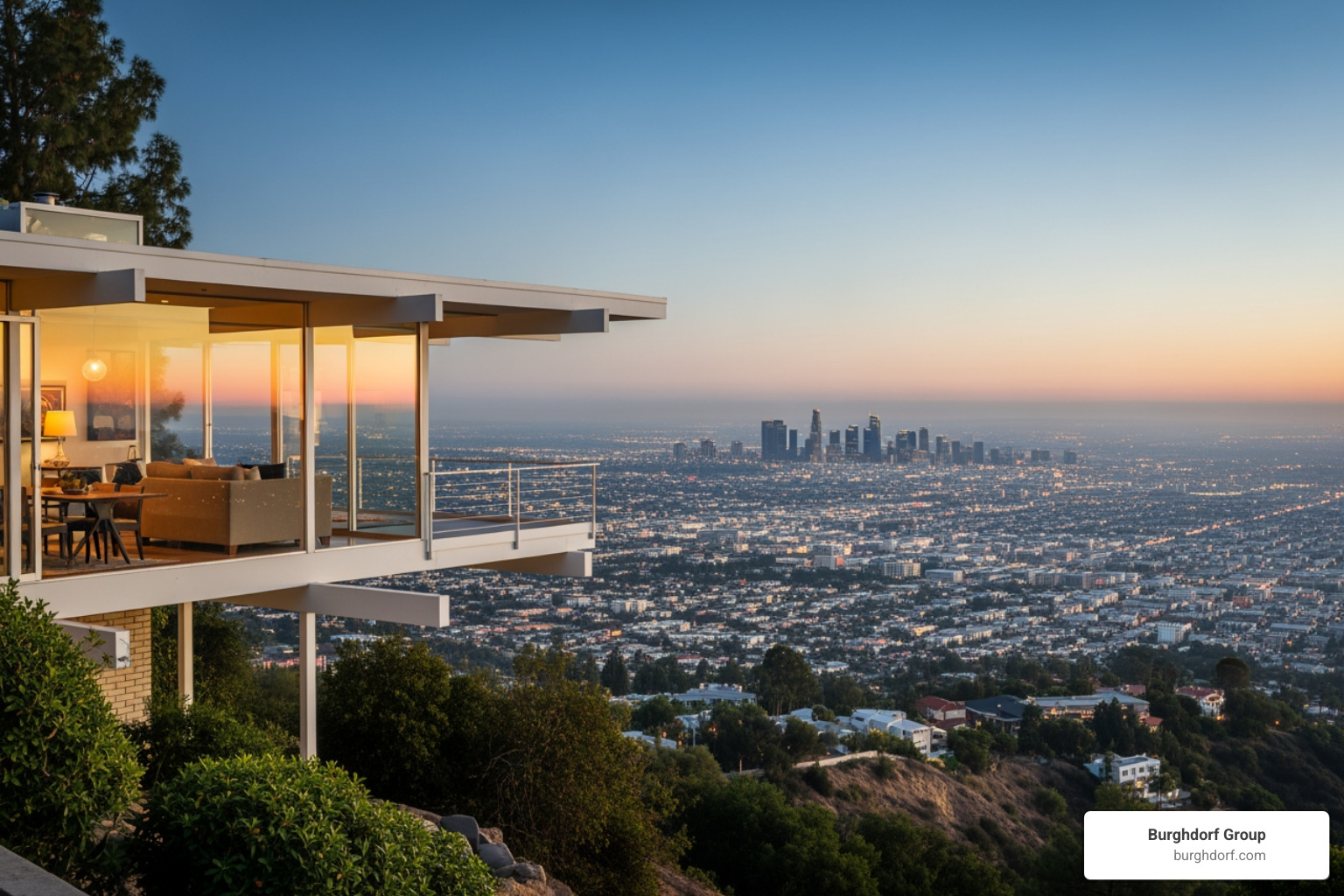
Hollywood Hills mid-century homes represent some of the most architecturally significant real estate in the United States — and right now, the market for them is more competitive than ever.
Here's a quick snapshot of what you need to know:
- What they are: Homes built roughly between 1945 and 1969, defined by flat roofs, floor-to-ceiling glass, open floor plans, and seamless indoor-outdoor living
- Who designed them: Legendary architects like Pierre Koenig, John Lautner, Richard Neutra, Edward H. Fickett, and A. Quincy Jones
- Where they're concentrated: Laurel Canyon, Beachwood Canyon, Nichols Canyon, and the hillside streets above the Sunset Strip
- What they cost today: The median list price in Hollywood Hills sits at $2,895,000, with an average of $1,198 per square foot and around 68 days on market
- Why they matter: Many carry Historic-Cultural Monument status, making them both protected landmarks and rare long-term investments
Few places in the world tell the story of postwar optimism through architecture the way Hollywood Hills does. After World War II, a generation of visionary architects looked at the steep, sun-drenched hillsides above Los Angeles and saw possibility. The result was a collection of homes that pushed the boundaries of what residential design could be — cantilevered over canyons, wrapped in glass, and built to dissolve the line between inside and out.
The Case Study House Program, launched in 1945 by Arts & Architecture magazine, was the spark. It challenged architects to design affordable, modern postwar homes — and Hollywood Hills became one of its most celebrated proving grounds. Pierre Koenig's Stahl House (Case Study House #22), completed in 1960 and recently listed at $25 million after 65 years of family ownership, is perhaps the most iconic image that program ever produced.
These homes were never just houses. They were ideas made livable — and buyers today are still drawn to exactly that.
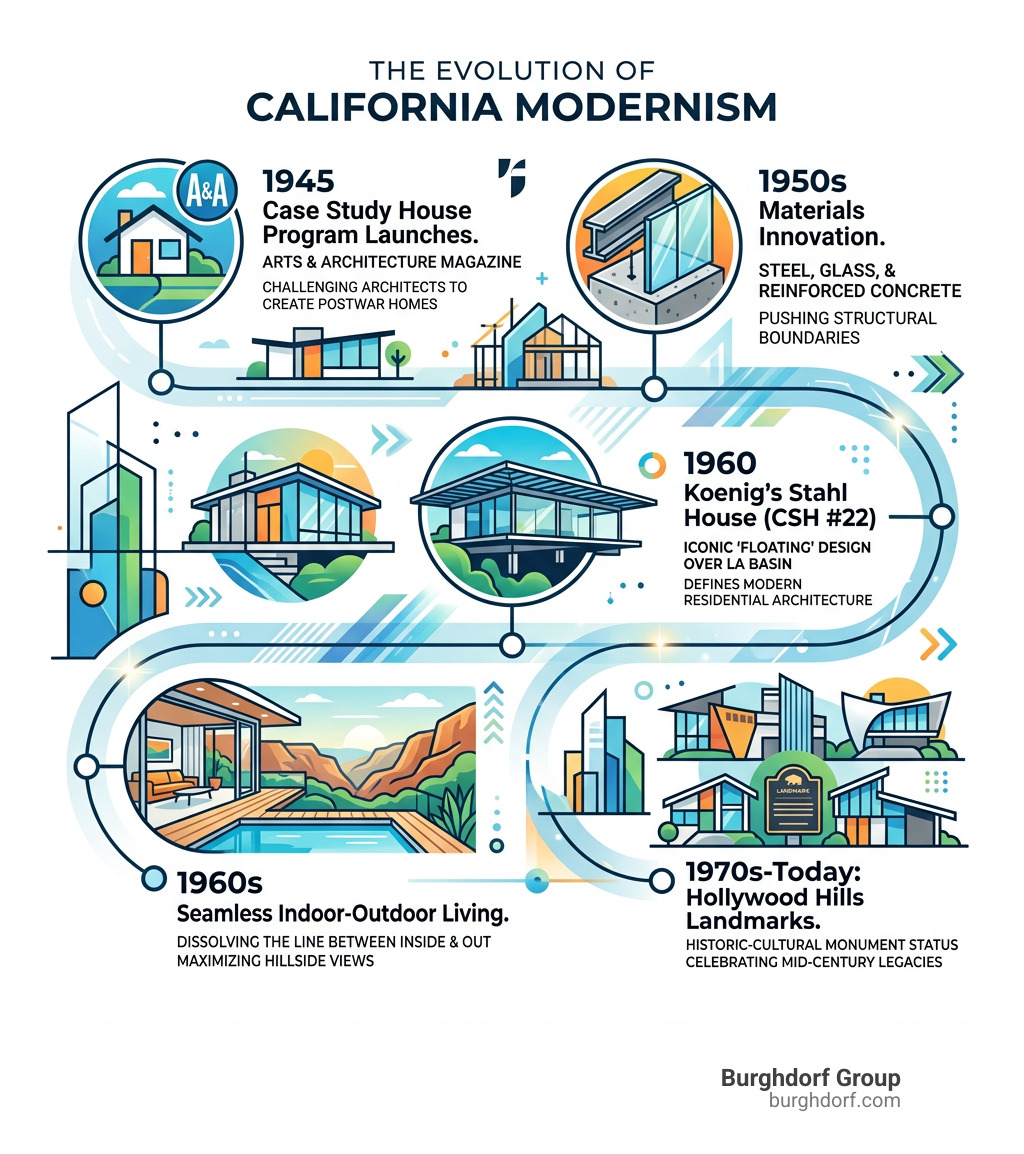
Defining the Aesthetic of Hollywood Hills mid-century homes
When we talk about Hollywood Hills mid-century homes, we aren't just talking about a time period; we’re talking about a specific architectural language. If you’ve ever walked into a home and felt like the backyard was part of the living room, you’ve experienced the "indoor-outdoor flow" that defines this era.
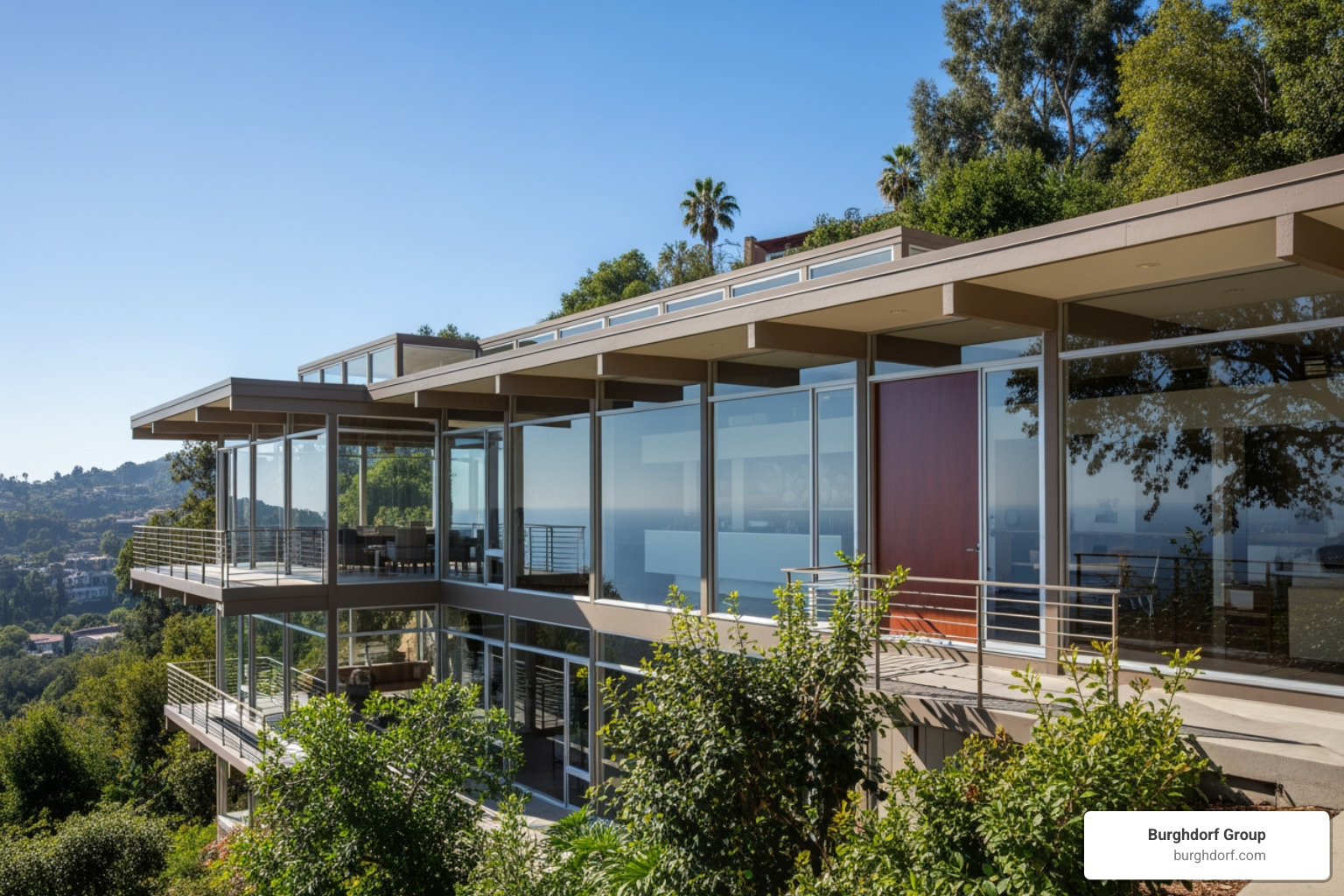
The aesthetic is rooted in several key features that were in the 1950s:
- Post-and-Beam Construction: This method allowed architects to move away from bulky load-bearing walls. By using a skeleton of posts and beams, they could install massive sheets of glass, creating "walls of light."
- Floor-to-Ceiling Glass: These aren't just windows; they are transparent boundaries. In homes like the Tanner House (9081 Wonderland Park Ave), glass allows the lush Laurel Canyon greenery to become part of the interior decor.
- Clerestory Windows: These narrow windows placed high near the roofline allow natural light to flood the home while maintaining privacy from neighbors—a must in the densely packed hills.
- Flat or Low-Slung Roofs: Horizontal lines were king. Whether it’s a perfectly flat roof or a dramatic "folding plate" design, these homes were meant to sit low and hug the topography of the hills.
- Geometric Simplicity: You won't find ornate moldings here. The beauty comes from the materials—wood, steel, stone, and concrete—and the clean, sharp lines they create.
This style isn't just a local phenomenon; it’s a celebrated culture. For those who want to dive deeper into this world, Modernism Week in Palm Springs offers an incredible look at how these design principles evolved across Southern California. In the Hollywood Hills, however, the "organic integration" is unique because the architects had to contend with verticality, often perching these glass boxes on stilts to capture "jetliner" views of the Los Angeles basin.
Iconic Architects and Their Masterpieces
The Hollywood Hills served as a blank canvas for the greatest architectural minds of the 20th century. These weren't just builders; they were visionaries who treated steel and glass like poetry.
Pierre Koenig and the Stahl House
If there is a "main character" in the story of Hollywood Hills mid-century homes, it is the Stahl House (Case Study House #22). Designed by Pierre Koenig for Buck and Carlotta Stahl in 1960, this L-shaped glass marvel cantilevers over a breathtaking precipice. For 65 years, it remained in the Stahl family, serving as a "living museum" with its original radiant heating and plywood cabinets. Recently listed for $25 million, its sale represents a "passing of responsibility" to a new custodian. You can learn more about its incredible journey through The Stahl House legacy.
John Lautner: Radical Geometry
John Lautner, a protege of Frank Lloyd Wright, took mid-century modernism into the realm of the futuristic. His 1953 masterpiece, the Bergren Residence at 7316 Caverna Dr, is a testament to his use of radical geometry and organic materials. Currently valued at nearly $3 million, Lautner's designs often feel like they belong in a sci-fi film—most notably the "Chemosphere," which sits like a flying saucer atop a concrete pedestal.
A. Quincy Jones and Early Modernism
A. Quincy Jones played a pivotal role in defining the Los Angeles architectural identity. His first-ever commissioned work, located at 2362 Stanley Hills Dr, is a "treehouse-like" residence built in 1940 that set the stage for the mid-century boom. It sold for $1.8 million and exemplifies how early modernism sought to incorporate the surrounding landscape. For those interested in how these styles influenced neighboring areas, check out more info about West Hollywood architecture.
Edward H. Fickett and Clyde Grimes
Edward H. Fickett is the "architect of the masses," known for bringing high-design post-and-beam style to thousands of homes. A prime example is 3122 Nichols Canyon Road, a 1959 gem featuring a central atrium with a water feature, recently listed for $2,995,000.
Meanwhile, the Maurice Seiderman House at 3306 Deronda Dr tells a story of Hollywood royalty. Built for the makeup artist behind Citizen Kane, it was designed by Clyde Grimes—a Tuskegee Airman who became California’s Official State Architect. This estate, which sits on nearly a full acre, was recently restored by a "dream team" including Pam Shamshiri and Barbara Bestor. To see how this compares to luxury styles in nearby enclaves, see more info about Beverly Hills mid-century style.
Neighborhood Hotspots: From Laurel Canyon to Beachwood
Not all canyons are created equal. Each pocket of the Hollywood Hills offers a slightly different flavor of mid-century living.
Laurel Canyon: The Bohemian Heart
Laurel Canyon is legendary for its creative pedigree. In the 1960s and 70s, it was the home of rock royalty like Jim Morrison and Joni Mitchell. Today, it remains a hotspot for Hollywood Hills mid-century homes, particularly in the "Wonderland School District." Properties like 8516 Allenwood Road—a 1959 retreat with original stonework and a lush backyard—command prices around $2.8 million. It’s a neighborhood for those who value privacy and a "bohemian spirit."
Beachwood Canyon: Under the Sign
If you want to live in the shadow of the Hollywood Sign, Beachwood Canyon is the place. It’s home to the Maurice Seiderman House and offers some of the most dramatic views in the city. The area is known for its "architectural enclaves" where 1950s post-and-beam homes sit side-by-side with historic castles. For a broader look at what’s available, explore more info about Hollywood Hills properties.
Nichols Canyon and the Sunset Strip
Nichols Canyon is often described as a "creative sanctuary." It’s quieter and more secluded than the bustling Sunset Strip but still features high-end architectural estates like the Fickett-designed home on Nichols Canyon Road. These areas are prized for their "jetliner views" that stretch from Downtown LA to the Pacific Ocean.
Market Trends and Preservation Guidelines
Buying a piece of history comes with both prestige and responsibility. The market for Hollywood Hills mid-century homes is robust, driven by a limited inventory of authentic, well-preserved structures.
Current Market Data (As of Early 2025):
- Median List Price: $2,895,000
- Average Price Per Square Foot: $1,198.13
- Average Days on Market (DOM): 68 days
- Total Inventory: Approximately 365 properties currently listed in the Hollywood Hills area.
Preservation and Stewardship
Many of these homes are designated as Historic-Cultural Monuments (HCM). While this status provides prestige and potential tax benefits, it also means that significant changes are subject to review. According to LA City preservation guidelines, the goal is to ensure that "custodians" of these homes honor their architectural purity.
Restoration efforts often involve a delicate balance. Modern buyers want updated kitchens with Sub-Zero appliances and smart home systems (like Crestron or Nest), but they also want to keep the original 1950s fireplace and clerestory windows. Successful restorations, like those seen in Beachwood Canyon, use designers who specialize in "mid-century roots" while updating for contemporary luxury. For those looking for similar architectural styles at different price points, you might find more info about Sherman Oaks listings helpful.
Frequently Asked Questions
What is the average price of Hollywood Hills mid-century homes?
As of February 2025, the median list price for homes in the Hollywood Hills is $2,895,000. However, mid-century modern "gems" with verified architect pedigrees often command a luxury premium. You can expect to pay between $1,100 and $1,300 per square foot for a well-maintained property, though iconic estates like the Stahl House can reach upwards of $25 million.
Who are the most famous architects associated with these properties?
The "Big Four" often cited by collectors are Pierre Koenig (known for steel and glass), John Lautner (known for space-age organic designs), Richard Neutra (the master of indoor-outdoor flow), and Edward H. Fickett (who popularized the post-and-beam ranch). Other notable names include A. Quincy Jones, Buff & Hensman, and Clyde Grimes.
Are Hollywood Hills mid-century homes protected from demolition?
Not automatically. Protection usually comes if a home is designated a Historic-Cultural Monument (HCM) or is part of a Historic Preservation Overlay Zone (HPOZ). Even with HCM status, a home isn't entirely protected from demolition, but any significant changes must go through a rigorous review process. Most owners of these homes view themselves as "stewards" rather than just owners, prioritizing the preservation of the home's architectural integrity.
Conclusion
At the Burghdorf Group, we understand that buying one of the many Hollywood Hills mid-century homes is more than a real estate transaction—it’s an acquisition of art. These residences stand as luminous testaments to an era when architecture was about more than just shelter; it was about a lifestyle of light, air, and optimism.
Our team brings intimate local market knowledge and a proven track record of successful transactions to help you navigate this complex market. Whether you are looking for a restored Lautner masterpiece or a Fickett ranch ready for its next chapter, we are here to guide you through the process of architectural stewardship and investment.
Ready to find your own piece of California Modernism? Explore Hollywood Hills mid-century homes with us today and discover why these "marvels" continue to define the Los Angeles skyline.