
Your Step-by-Step Guide to Owning a Piece of the City of Angels
Why Buying Property in Los Angeles Is One of the Biggest Financial Decisions You'll Ever Make

Buying property in Los Angeles is a major move — and one that requires serious preparation. Here's a quick overview of what the process looks like:
The 9 core steps to buying a home in LA:
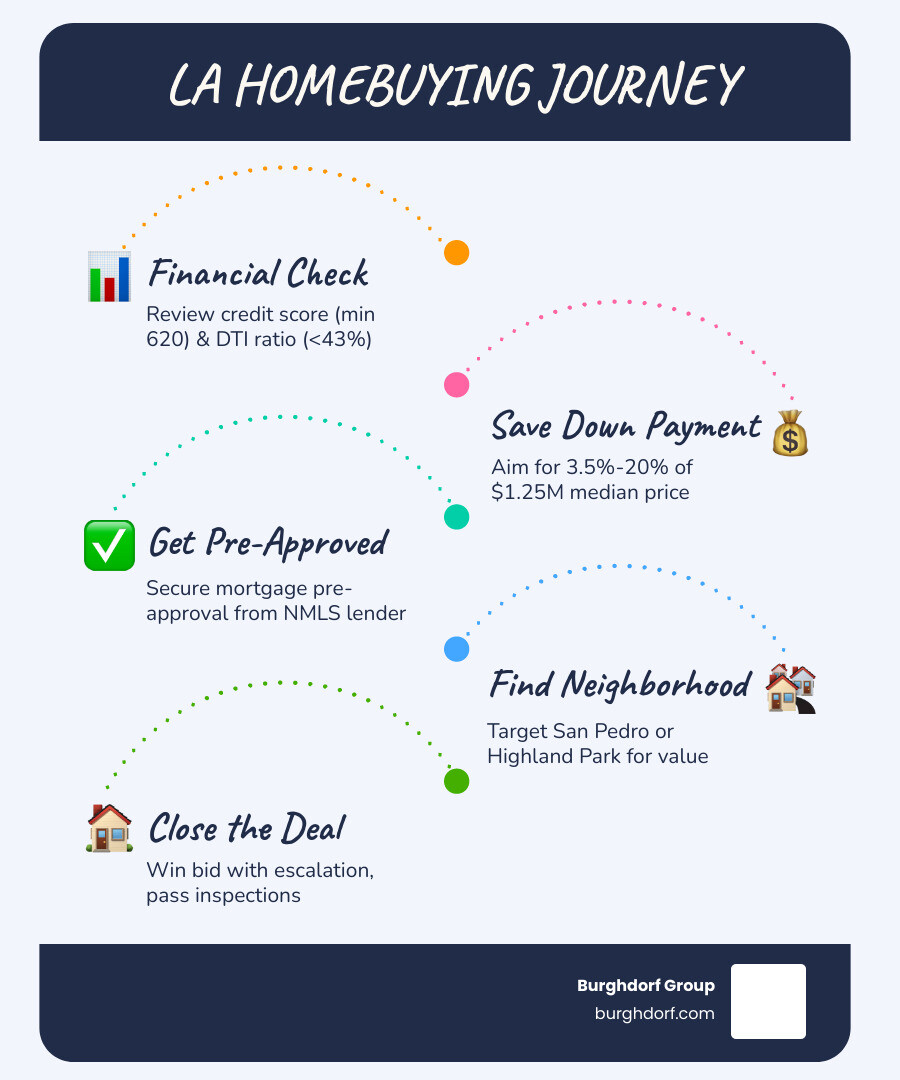
- Check your credit score and debt-to-income ratio
- Save for a down payment (3.5%–20% of purchase price)
- Explore local assistance programs like LIPA, MIPA, and MCC
- Get mortgage pre-approval
- Choose your target neighborhood and property type
- Work with a local real estate agent
- Search listings and attend open houses
- Make a competitive offer (with escalation clause if needed)
- Complete inspections, appraisal, and close
Los Angeles is one of the most competitive real estate markets in the country. The median listing price sits around $1.25 million, and even entry-level homes in desirable neighborhoods routinely spark bidding wars.
That said, homeownership here is not out of reach — it just demands a clear strategy.
Whether you're eyeing a luxury home in Santa Monica, a condo in Silver Lake, or a stepping-stone property in an up-and-coming neighborhood, the path to ownership starts with understanding the full picture: your finances, the neighborhoods, the property types, and the competitive dynamics of the LA market.
This guide walks you through every step.
Financial Readiness for Buying Property in Los Angeles
Before you start picking out paint colors for a bungalow in Venice, we need to talk numbers. The "LA Tax" isn't just a figure of speech; it’s a reality of our local market. With median home prices often exceeding $800,000 and the average listing hovering around $1.25 million, financial readiness is the foundation of your journey.
Income Requirements
How much do you actually need to earn? While it varies by neighborhood, general industry insights suggest a household income of at least $200,000 is often necessary to comfortably afford a median-priced home here. If you are looking at entry-level homes in the $700,000 to $900,000 range, an income between $131,000 and $200,000 can work, especially if you have minimal debt and a solid down payment.
Credit Score and DTI
Your credit score is your "VIP pass." To qualify for a conventional mortgage, you’ll generally need a score of 620 or higher. However, to snag those ultra-competitive interest rates, aim for 740+. For FHA loans, you can sometimes qualify with a score as low as 580.
Equally important is your Debt-to-Income (DTI) ratio. Lenders typically want to see your total monthly debt payments (including your future mortgage) stay under 36% of your gross monthly income. In a high-cost market like ours, some lenders may stretch to 43% or even 50% for certain programs, but keeping it lower gives you more breathing room for, you know, eating and enjoying the city.
| Feature | FHA Loan | Conventional Loan |
|---|---|---|
| Min. Down Payment | 3.5% | 3% - 20% |
| Min. Credit Score | 580 (for 3.5% down) | 620 |
| Mortgage Insurance | Required for life of loan | Can be removed at 20% equity |
| Loan Limits | Varies by county | Generally higher limits |
To ensure you are working with legitimate professionals, you can verify lenders through the NMLS Consumer Access portal. Understanding mortgage licensing and disclosures is a critical step in protecting your investment.
Realistic Down Payments and Closing Costs
There is a common myth that you must have 20% down. While 20% on a $960,000 home is a staggering $192,000, it’s not the only way.
- The 20% Traditional Route: This is ideal because it eliminates Private Mortgage Insurance (PMI) and lowers your monthly payment.
- The 3.5% FHA Route: Popular for first-time buyers, though it comes with permanent mortgage insurance premiums.
- The 12% California Average: Interestingly, the average down payment in California is actually around 12%. Many buyers find this middle ground more achievable.
Don't forget closing costs. In Los Angeles, you should budget between 3% and 6% of the purchase price for closing costs. On a $1 million home, that’s an extra $30,000 to $60,000 due at the end of the transaction. You can view more info about Los Angeles properties to see how these numbers play out in real-time listings.
Local Assistance Programs: LIPA, MIPA, and MCC
If the numbers feel daunting, the City of Los Angeles Housing Department (LAHD) offers several "hidden gem" programs:
- LIPA (Low Income Purchase Assistance): Provides loans for low-income first-time buyers to cover down payments and closing costs.
- MIPA (Moderate Income Purchase Assistance): Tailored for those earning a bit more but still needing a boost to compete in the Los Angeles market.
- MCC (Mortgage Credit Certificate): This is a federal tax credit that allows you to deduct 20% of your annual mortgage interest directly from your tax liability. It effectively boosts your qualifying income.
Additionally, you can explore FHA Gift Funds and CalHFA programs, which allow family members to help you with your down payment without tax penalties. For our veterans, VA loan benefits for Californians often allow for 0% down payments, which is a massive advantage in our high-priced landscape.
Navigating the Los Angeles Neighborhood Landscape
Location isn't just about a zip code; it’s about your lifestyle. In LA, your "neighborhood" determines your commute, your morning coffee spot, and your property’s appreciation potential.
Market Trends and Commutes
The average commute in LA is about 30 minutes, but anyone living here knows that "30 minutes" can quickly turn into an hour if you’re crossing the 405 at the wrong time. We always recommend choosing a location based on your "commute tolerance." If you work in Santa Monica, buying in Encino might give you more house for your money, but you’ll pay for it in time spent on the road.
Schools and Safety
For many families, school quality is the primary driver. We suggest checking GreatSchools ratings for specific districts. Areas like Pacific Palisades and Brentwood are renowned for their excellent schools and safety records, which also helps maintain high resale values. If you're ready to dive into the details, you can explore Pacific Palisades real estate to see the premium these amenities command.
Best Neighborhoods for Buying Property in Los Angeles on a Moderate Income
If you’re earning between $131,000 and $200,000, you might feel priced out of the "coolest" spots, but there is still incredible value to be found:
- San Pedro: Offers a coastal vibe and historic bungalows at a fraction of the price of the Westside.
- North Hollywood (NoHo): A hub for arts and culture with great public transit access.
- Highland Park: While it has gentrified significantly, it remains a favorite for those seeking a trendy, walkable lifestyle with slightly more attainable entry points than Silver Lake.
For those looking for a balance of coastal living and value, our Santa Monica market insights can help you identify pockets that might fit your budget.
Is Buying Property in Los Angeles Desirable Areas Realistic?
Is it possible to buy in Silver Lake, Echo Park, or Culver City with aggressive saving? Yes, but you have to be strategic.
Many successful buyers use the "stepping-stone" method. They start with a condo or a fixer-upper in an "up-and-coming" area, build equity for 3–5 years, and then "trade up" to their dream home. Aggressive saving (living with roommates or cutting back on that $9 Highland Park latte) can help you build a down payment faster.
If your budget allows for the pinnacle of LA living, the luxury real estate in Beverly Hills offers some of the most iconic properties in the world, with median prices often exceeding $5 million.
Choosing Your Property Type: Condos vs. Single-Family Homes
When buying property in Los Angeles, the type of home you choose affects your daily life and your wallet.
Single-Family Homes (SFH)
The "California Dream" usually involves a detached house with a yard.
- Pros: Total control over the property, no shared walls, higher appreciation potential.
- Cons: You are 100% responsible for maintenance (the 1% rule: budget 1% of the home's value annually for repairs).
Condominiums
- Pros: Usually more affordable, amenities (pools, gyms), and less exterior maintenance.
- Cons: HOA Fees. These can range from $300 to over $1,000 a month. You must also watch out for "special assessments" — one-time fees for major repairs like a new roof or elevator. We always advise our clients to review the HOA's meeting minutes and "reserve funds" before buying.
In areas like Brentwood, the choice between a luxury condo and a single-family home often comes down to how much "lock-and-leave" flexibility you desire.
The Pros and Cons of Starting with a Townhome
Townhomes are the middle ground. They offer more space than a condo but often come with lower price tags than a detached home.
- Pros: Great for equity building; often feel more like a "house" with private entrances.
- Cons: Shared walls and some HOA restrictions.
To see what’s currently available across all these categories, you can view current Los Angeles listings.
Winning the Bidding War: Making a Competitive Offer
In LA, if you love a house, chances are five other people do too. Making a competitive offer is an art form.
- Escalation Clauses: This tells the seller, "I will pay $X more than your highest offer, up to a limit of $Y." This can keep you in the running without overpaying.
- Clean Contingencies: While we never recommend waiving an inspection, having a pre-approved loan and a quick appraisal period makes your offer much more attractive.
- Personalized Letters: Sometimes, telling the seller why you love their home can tip the scales in a tie-breaker. (Though some agents avoid these for fair housing reasons, they can still be impactful).
- The Right Agent: A local expert knows the listing agents and how to negotiate. Knowing how to select the best real estate agent in Los Angeles is often the difference between a "Yes" and a "Thank you, next."
Ongoing Costs of Homeownership in LA
Your mortgage is just the beginning. Make sure your monthly budget includes:
- Property Taxes: Roughly 1.25% of the assessed value. On a $1.25M home, expect $15,625 per year.
- Homeowners Insurance: Generally $900–$1,700/year, though fire insurance can be higher in canyon areas like Hollywood Hills.
- Mello-Roos: Some newer developments (common in areas like Calabasas or Sherman Oaks) have extra assessments for local infrastructure.
Frequently Asked Questions about Buying Property in LA
How much income do I need to afford a house in Los Angeles?
While you can find properties in the $500k range in the far reaches of the county, for a standard home in the city, a household income of $150,000 to $200,000 is the realistic baseline. If you're looking at luxury hubs like Beverly Hills or Malibu, your income and assets will need to be significantly higher.
Is it better to buy now or wait for the market to cool?
"Timing the market" is notoriously difficult in Los Angeles. Because inventory is so low (currently around 9,500 active listings for a massive population), prices tend to remain resilient. If you find a home you love and can afford the payment, buying now allows you to start building equity immediately. LA property has historically been an excellent long-term investment.
Can I buy a home solo or should I consider co-buying?
Buying solo is possible, but many Angelenos are turning to "co-buying" with partners, friends, or family members to pool resources. This can double your effective income and halve your down payment burden. Just ensure you have a clear legal agreement in place before signing the papers!
Conclusion
Buying property in Los Angeles is a marathon, not a sprint. It requires financial discipline, a bit of thick skin for bidding wars, and a deep understanding of the local micro-markets. From the beachy vibes of Venice to the mountain retreats of Malibu, this city offers a lifestyle like no other.
At Burghdorf Group, we pride ourselves on our intimate local market knowledge and our proven track record of helping buyers navigate this complex landscape. Whether you are a first-time buyer or looking for a luxury estate, we are here to guide you through the final walkthrough and beyond.
Ready to find your place in the City of Angels? Start your journey of buying property in Los Angeles with us today.