
Why Invest in Multi-Family Properties in Los Angeles: The Big City Payoff
Los Angeles Has a Housing Crisis — And That's Exactly Why Investors Are Paying Attention
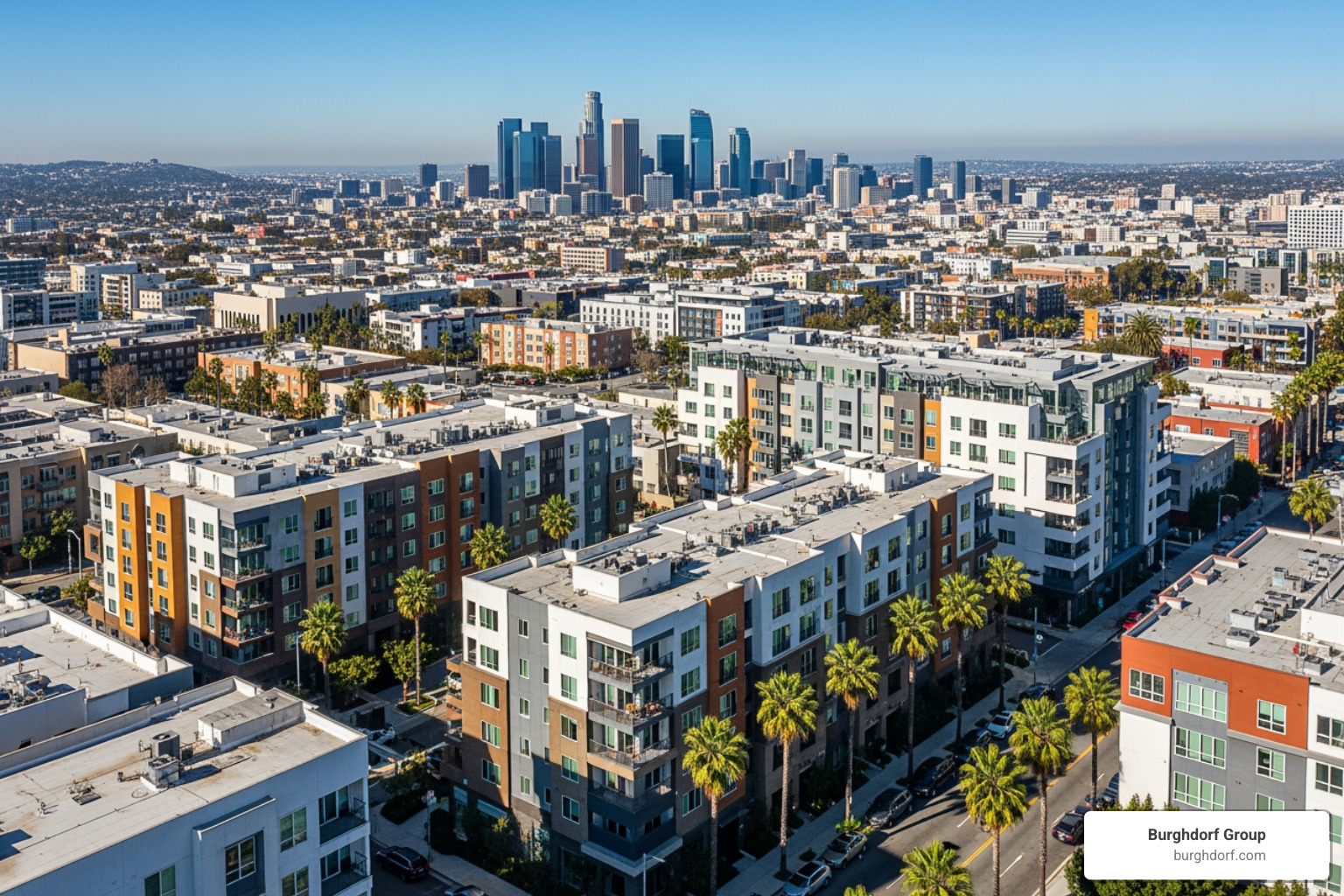
Why invest in multi-family properties in Los Angeles is one of the most important questions any serious real estate investor can ask right now. Here's the short answer:
Top reasons to invest in LA multi-family real estate:
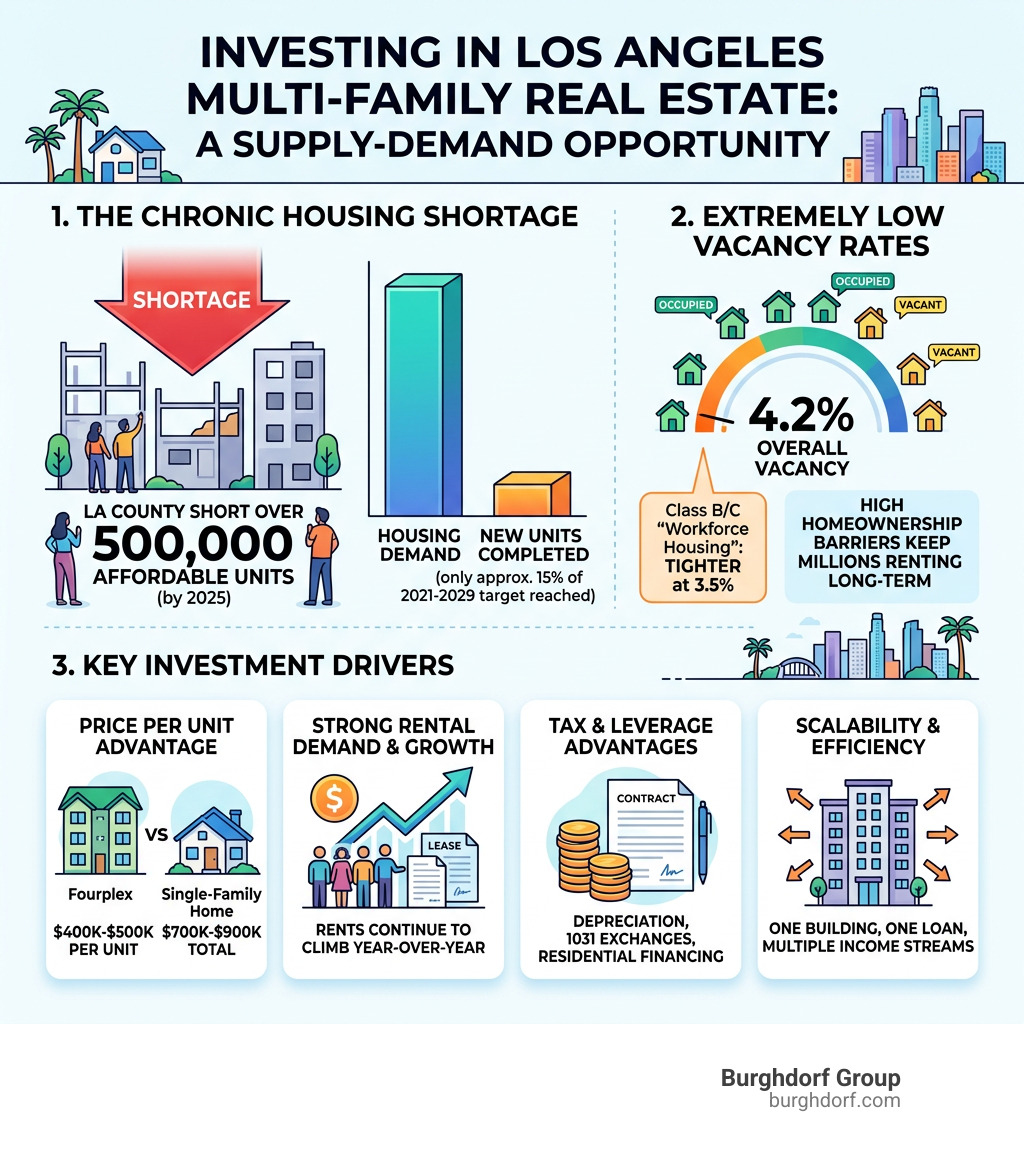
- Chronic housing shortage — LA County is short over 500,000 affordable units as of 2025
- Low vacancy rates — Overall vacancy sits near 4.2%, with workforce housing (Class B/C) even tighter at 3.5%
- Strong rental demand — High homeownership barriers keep millions renting long-term
- Price per unit advantage — Fourplex units cost $400K–$500K vs. $700K–$900K for single-family homes
- Rent growth — Even in slower years, rents have continued to climb year-over-year
- Tax and leverage advantages — Depreciation, 1031 exchanges, and residential financing make multi-family uniquely efficient
- Scalability — One building, one loan, multiple income streams
Los Angeles has faced a housing supply problem for nearly five decades. At its core, it's simple: too many people need housing, and not enough units exist to meet that need.
The city's 2021–2029 housing plan targets over 456,000 new units. As of December 2024, only about 15% of that goal has been completed. That gap isn't closing fast.
Meanwhile, high mortgage rates have kept would-be homebuyers in the rental market longer than expected. Renters who might have bought a home are staying put — and competing for the same limited rental supply.
For investors, that supply-demand imbalance is not a problem. It's the opportunity.
Whether you're a seasoned investor looking to grow your portfolio or an affluent professional exploring real estate as a wealth-building vehicle, understanding the LA multi-family market can change how you think about long-term returns.
This guide breaks down exactly why LA multi-family investing makes sense — the market data, the strategic advantages, the regulatory landscape, and the best submarkets to watch.
Why Invest in Multi-Family Properties in Los Angeles Now?
When we look at the current landscape, the most compelling reason to consider why invest in multi-family properties in Los Angeles is the sheer resilience of the asset class. While headlines often focus on population shifts, the ground-level reality is that Los Angeles remains a primary destination for global talent, entertainment, and technology.
The market fundamentals tell a story of stability. According to 4.2% vacancy per CoStar Market Analytics Q4 2025 Summary, the county continues to face a persistent housing shortage. This shortage sustains rental demand even during economic fluctuations. In fact, while luxury Class A properties saw slightly higher vacancies (around 5.5%) due to new construction, Class B and C "workforce housing" remained incredibly tight at 3.5% vacancy in 2024.
This means that properties catering to the average Angeleno—the teachers, nurses, and service professionals—are essentially "recession-resistant." These tenants aren't moving to out-of-state mansions; they are staying in the city where the jobs are. When you browse our Properties Tag Los Angeles, you’ll see that the inventory constraints are real. Land is scarce, and the barriers to entry for new developers are high, which protects the value of existing multi-family assets.
Strategic Advantages of Why Invest in Multi-Family Properties in Los Angeles
One of the most frequent conversations we have with clients is the comparison between a single-family rental and a multi-family building. If you buy one house and the tenant leaves, you have 100% vacancy and 0% income. If you buy a fourplex and one tenant leaves, you still have 75% of your income flowing in. This risk diversification is a cornerstone of smart wealth building.
Furthermore, there is a significant "price per unit" advantage. In the current market, a single-family home in a desirable neighborhood might cost you $800,000 to $900,000. However, in a fourplex, the cost per unit often drops to $400,000 or $500,000. You are essentially buying "wholesale" units rather than "retail" homes.
| Metric | Single-Family Home (SFH) | Multi-Family (2-4 Units) |
|---|---|---|
| Average Cost per Unit | $700K - $900K | $400K - $500K |
| Vacancy Risk | Binary (100% or 0%) | Diversified (e.g., 25% increments) |
| Financing Type | Residential | Residential (up to 4 units) |
| Scalability | Low (1 loan per house) | High (1 loan for multiple units) |
| Management | Often self-managed | Professional management viable |
As you explore Properties - For Sale, consider the "house hacking" strategy. By utilizing FHA or VA loans, which require as little as 3.5% or 0% down, an investor can live in one unit and rent out the others. This allows you to enter the LA market with much less capital while your neighbors effectively pay your mortgage.
Maximizing ROI: Why Invest in Multi-Family Properties in Los Angeles Submarkets
For those looking to maximize their Return on Investment (ROI), the "value-add" strategy is king. This involves finding a property with "deferred maintenance" (a polite way of saying it needs some love) and renovating it to command higher market rents. This creates "forced appreciation"—you aren't just waiting for the market to go up; you are actively increasing the building's value through improvements.
The tax benefits are equally impressive. Residential multi-family properties can be depreciated over a 27.5-year period. This "paper loss" can often offset the actual cash flow you receive, leading to tax-efficient income. When it comes time to sell, savvy investors use 1031 exchanges to defer capital gains taxes by rolling their profits into a larger property.
As noted in the COMMERCIAL REAL ESTATE REPORT Q3 2023 by NAR, the absorption of units in LA remains healthy. Looking at our Properties - Sold section, it's clear that properties priced correctly and located in high-demand submarkets don't sit on the market for long.
Market Fundamentals and the 2025-2026 Outlook
Looking ahead to 2025 and 2026, the LA multi-family market is being reshaped by massive infrastructure projects. The most significant of these is LA Metro’s D (Purple) Line Extension and Westside Connector. As this project nears completion in 2026, transit-oriented developments (TODs) are becoming the "gold mine" of the rental market.
Renters in LA are tired of the 405 freeway. They are increasingly willing to pay a premium to live near a Metro station. Mixed-use assets—buildings that combine housing with ground-floor retail or cafes—are showing much higher rent resilience and faster absorption rates.
We are also seeing a stabilization in rent growth. After the wild swings of the early 2020s, rents are settling into a more predictable 2% to 4% year-over-year increase. For an investor, predictability is a gift; it allows for much more accurate long-term pro-forma modeling.
The capital markets are also becoming more accessible. While interest rates were a hurdle in 2023 and 2024, the outlook for 2025 suggests a more stabilized lending environment. Agencies like Fannie Mae and Freddie Mac have increased their multi-family lending caps, making it easier for investors to secure financing for stabilized assets. You can see the impact of these trends in our Properties - Recent listings, where newer, transit-adjacent properties are leading the market.
Navigating LA’s Regulatory Landscape and Zoning Laws
We won't sugarcoat it: Los Angeles has a complex regulatory environment. Between the city's Rent Stabilization Ordinance (RSO) and the state's AB 1482, you need to know what you’re buying.
- RSO (Rent Stabilization Ordinance): Generally applies to buildings in the City of LA built before October 1, 1978. It strictly limits how much you can raise rent on existing tenants.
- AB 1482: A statewide law that covers newer buildings (older than 15 years) and limits rent increases to 5% plus the local CPI (inflation).
- Costa-Hawkins Act: This is an investor's best friend. it prevents cities from implementing "vacancy control." This means that when a tenant moves out, you can reset the rent to full market rates.
Our Luxury Realtors Los Angeles are experts at navigating these nuances. We also help clients leverage new "gentle density" laws like SB 684 and SB 1123. These bills allow for the development of up to 10 units on certain single-family lots, creating massive opportunities for small-scale developers to add value to underutilized Properties.
Additionally, investors should be aware of the "Mansion Tax" (ULA) on properties over $5 million and requirements for seismic retrofitting. While these add to the cost of doing business, they also serve as a barrier to entry that keeps the competition at bay for those who have the expertise to manage them.
Top LA Submarkets for Multi-Family Investment Potential
Not all LA neighborhoods are created equal. When considering why invest in multi-family properties in Los Angeles, location dictates your vacancy rate and your appreciation potential.
- Santa Monica: The "Crown Jewel." With a blend of tech giants (Hulu, Oracle, Amazon) and world-class beaches, demand here is permanent. The local government is progressive and well-managed, making it a safe haven for capital.
- Beverly Hills & Brentwood: These areas offer unparalleled prestige. Multi-family assets here are often "legacy properties" that stay in families for generations. They offer lower yields but massive long-term appreciation.
- Westwood: Driven by UCLA and the upcoming Metro extension, Westwood is a hub for student and workforce housing that rarely sees a vacant unit.
- The South Bay: Areas like Manhattan Beach and Hermosa Beach offer a lifestyle appeal that attracts high-earning professionals who prefer the "beach vibe" over the urban core.
- San Fernando Valley: The Valley is the heart of workforce housing. With a lower entry price than the Westside, it offers some of the best cash-on-cash returns in the county.
Frequently Asked Questions about LA Multi-Family Investing
Is now a good time to invest in LA multi-family given current interest rates?
While rates are higher than the historic lows of 2021, they have stabilized. Many investors are finding success by negotiating "seller carry" financing or looking for properties with assumable loans. You marry the property but you only date the rate—you can always refinance when rates drop, but you can't "re-buy" a property at today's prices five years from now.
How does multi-family investing compare to stocks or single-family rentals?
Multi-family offers a "leverage advantage" that stocks don't. If you have $200,000, you can buy $200,000 in stocks. Or, you can use that $200,000 as a down payment on a $1 million multi-family building. If the building goes up 5% in value, you've made $50,000—a 25% return on your actual cash invested. Plus, you get the monthly rental income and tax write-offs that stocks simply can't match.
What are the main risks of investing in Los Angeles multi-family real estate?
The primary risks are management intensity and regulatory changes. LA is a "pro-tenant" city, meaning you must be diligent with tenant screening and stay compliant with local laws. High entry costs and competition from institutional investors are also factors. However, working with an experienced team like ours helps mitigate these risks through conservative underwriting and professional management connections.
Conclusion: Building Long-Term Wealth in Los Angeles
At the end of the day, the answer to why invest in multi-family properties in Los Angeles comes down to one word: scarcity. In a city where land is limited and the population's need for housing is infinite, owning a multi-unit building is one of the most reliable ways to build multi-generational wealth.
At Burghdorf Group, we don't just show you listings; we provide the intimate local market knowledge and a proven track record of successful transactions needed to navigate this complex landscape. Whether you are looking for a value-add fourplex in the Valley or a stabilized luxury asset in Santa Monica, we help you optimize your portfolio for both cash flow and appreciation.
The housing shortage isn't going away, and neither is the demand for the LA lifestyle. Now is the time to secure your piece of the Los Angeles skyline.
Start your Los Angeles investment journey with us today and see our Properties - Recent to find your next opportunity.