
Discount Brokerage vs Full Service: Which One Wins for Your Wallet
Is a Discount Broker Worth It? What Los Angeles Home Sellers Need to Know First

Whether a discount broker worth it calculation works in your favor depends on one thing most sellers overlook: the difference between commission saved and money actually pocketed.
Quick answer: Discount brokers can save sellers $6,000–$20,000+ in listing fees. But in competitive, high-value markets like Los Angeles, reduced marketing, weaker negotiation, and fewer offers can quietly erase those savings — and then some.
Here is what the numbers typically look like:
| Scenario | Commission Rate | On a $2M Home | Estimated Net Proceeds |
|---|---|---|---|
| Discount broker | 1.5%–2% listing fee | $30,000–$40,000 | Often lower sale price |
| Full-service agent | 2.5%–3% listing fee | $50,000–$60,000 | Often higher sale price |
| FSBO | ~0% listing fee | Minimal commission | Avg. $34,000 less than agent-assisted sales |
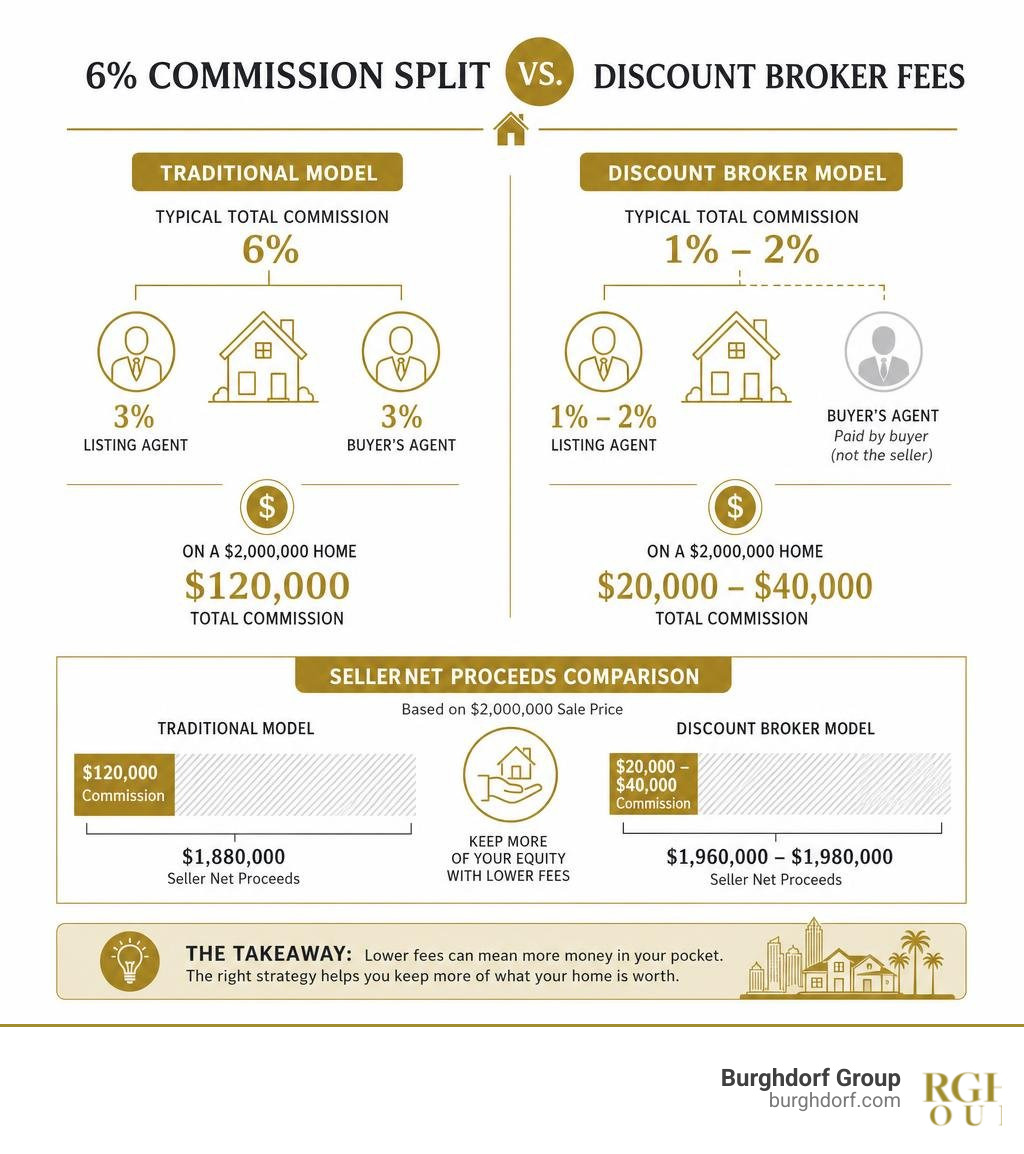
The national average listing-side commission sits at 2.88%, while discount brokers typically charge 1% to 2% — a real difference. But on a $2M Westside property, a 5% swing in sale price is $100,000. That dwarfs any commission saving.
This guide walks you through exactly how discount brokers work, what you give up, how the 2024 NAR settlement changed the math, and when the trade-off actually makes sense.
I'm Lolita Burghdorf, a Los Angeles real estate expert with nearly two decades of experience helping buyers and sellers navigate high-value transactions across Beverly Hills, Santa Monica, Brentwood, and beyond — markets where the discount broker worth it question has real financial stakes. Understanding both models deeply is what allows me to help clients protect their equity at every step.
What is a Discount Real Estate Broker and How Do They Work?
At its core, a discount real estate broker is a licensed professional or brokerage company that agrees to list and help sell your home for a fraction of the traditional commission rate. While a standard full-service listing agent in Los Angeles typically charges between 2.5% and 3% of the home's final sale price to represent the seller, a discount broker will slash that rate down to 1% to 2%, or charge a flat fee.
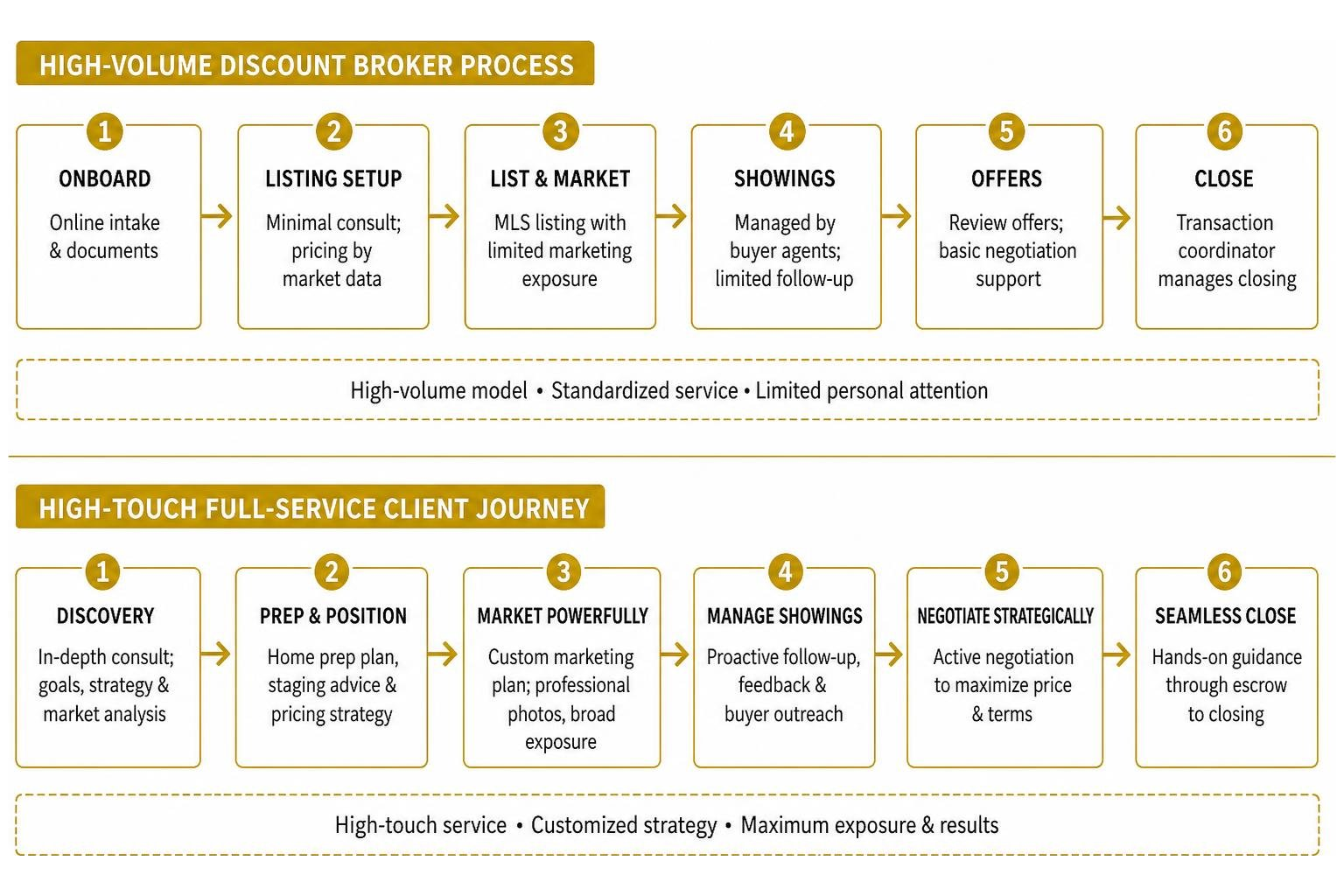
To offset these lower fees and remain profitable, discount brokerages operate on a high-volume business model. Instead of giving personalized, high-touch support to a select handful of clients, a discount agent might juggle dozens of listings simultaneously. They often rely heavily on automated technology, centralized customer service teams, and specialized software to streamline the transaction.
This streamlined approach can work well in cookie-cutter housing markets, but it presents unique challenges in highly nuanced, block-by-block Southern California neighborhoods. Understanding the structural differences between these models is crucial before deciding which path is right for your wallet. To dive deeper into the operational differences, check out this guide on Full-Service vs Discount Brokers: Key Differences.
The Main Types of Discount Brokerage Models
Not all discount real estate models are created equal. If you are exploring budget-friendly options in the Los Angeles area, you will generally run into one of these six structures:
- Discounted Commission Percentages: The most common model, where the broker offers standard representation but charges a lower listing rate (typically 1% to 1.5%). You can find these services through various platforms, such as those listed in 5 Best Low Commission Realtors in Los Angeles, California (2026).
- Flat-Fee MLS Only: For a small upfront payment (often $300 to $500), a broker will upload your home to the local Multiple Listing Service (MLS). Once the listing is active, the broker steps aside, leaving you to handle photography, showings, disclosures, and negotiations completely on your own.
- Limited Service Agents: These brokers charge a slightly higher flat fee (often around $3,000) to list your home on the MLS and provide basic templates for contracts, but they do not host open houses, provide professional staging, or actively market your property.
- Tiered Commission Structure: Under this model, you pay a sliding scale based on the level of support you want. For example, a basic package gets you MLS entry and digital contracts, while a premium package adds professional photography and limited negotiation help.
- The 2-for-1 Model: Some brokerages will waive or heavily discount your listing fee entirely on the condition that you also buy your next home through them. While this sounds highly appealing, it locks you into using the same agent for both transactions, which can limit your flexibility.
- Hybrid Discount Model: This structure combines salaried agents with automated transaction coordinators. Because the agents are paid a flat salary by the brokerage rather than a performance-based commission, the company can pass some savings onto you. However, this can sometimes reduce the agent's personal drive to fight for every last dollar at the negotiating table.
Is a Discount Broker Worth It for Basic MLS Exposure?
Many sellers assume that in the digital age, getting a home on the MLS is 90% of the battle. Since the MLS automatically syndicates your property to Zillow, Redfin, and Realtor.com, it is tempting to think a flat-fee MLS listing is all you need to attract buyers.
In some markets, basic exposure might suffice. If you are selling a highly standardized condo in an area with predictable demand, a simple MLS listing could bring in a buyer. However, if you are selling a luxury estate in Calabasas, a historic property in Venice, or a architectural home in the Hollywood Hills, basic MLS exposure is rarely enough to maximize your return.
High-net-worth buyers and investors do not just look at Zillow; they rely on off-market networks, targeted digital campaigns, and curated broker previews. Without active marketing, professional staging, and local networking, a property can easily sit on the market, developing a "stale" reputation that invites lowball offers. Knowing how to position your home beyond a basic MLS entry is the key to securing top dollar. For a detailed roadmap on selecting the right representative for your specific property, see our guide on How to Select the Best Real Estate Agent in Los Angeles.
Weighing the Pros and Cons: Is a Discount Broker Worth It?
To truly determine if a discount broker worth it scenario applies to your situation, you must carefully weigh the immediate financial savings against the long-term operational risks.
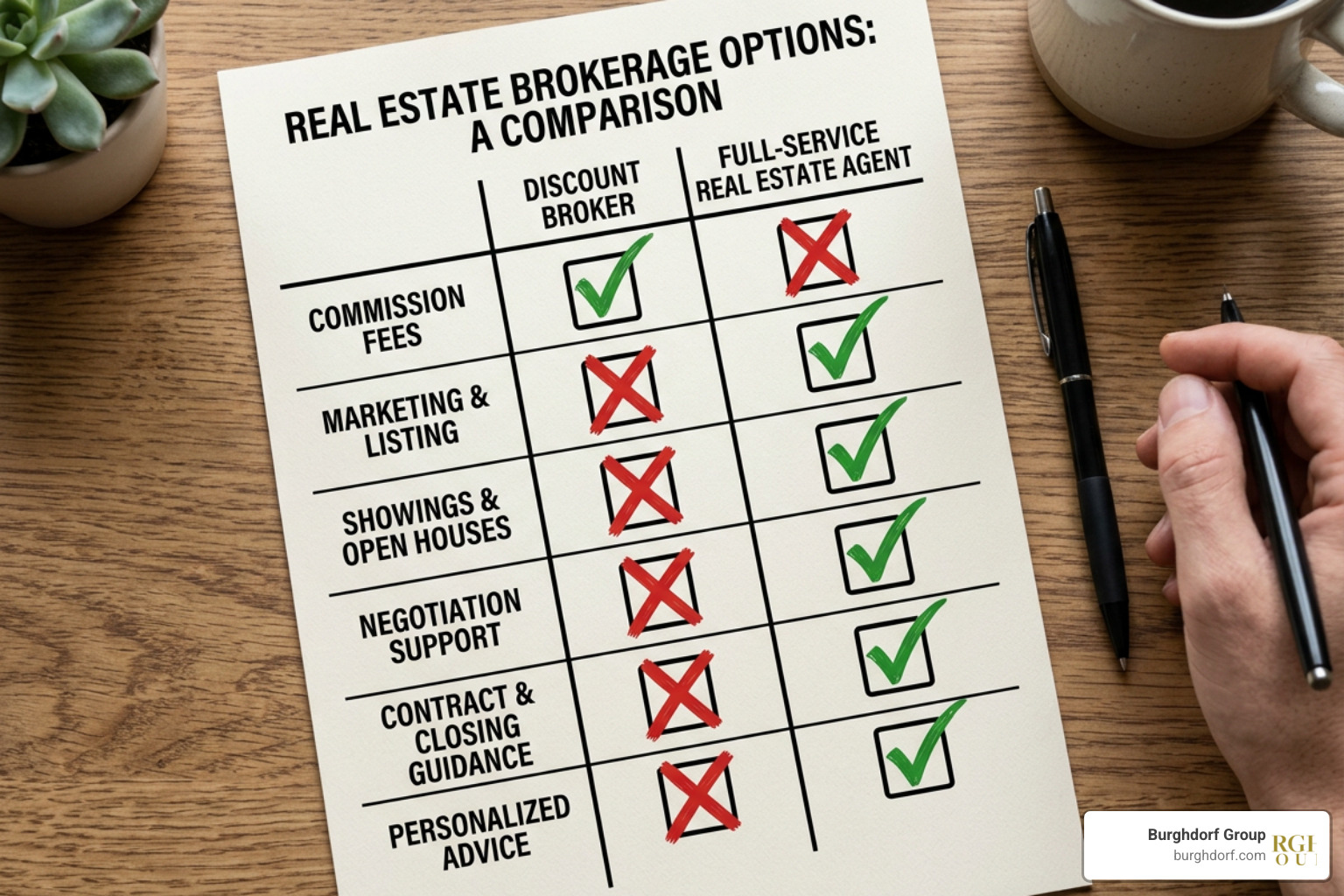
Let’s look at how the deliverables compare side-by-side:
| Deliverable / Service | Typical Discount Broker | Burghdorf Group (Full-Service) |
|---|---|---|
| Listing Commission | 1% to 1.5% | 2.5% to 3% |
| Professional Photography & 3D Tours | Often an extra charge or basic quality | Included (High-end HDR & video) |
| Home Staging & Design Consultation | Excluded (Sellers must arrange) | Included (Professional staging & design) |
| Agent Availability & Communication | Centralized team, limited hours | 24/7 dedicated local advisor |
| Negotiation Strategy | High-volume, automated advice | Bespoke, highly strategic negotiation |
| Local Broker Networking | Minimal | Deep connections in LA luxury networks |
For more insights on choosing the right professional for your transaction style, read the analysis on Full-Service vs Discount Brokers: How to Choose the Right Trading Partner.
The Advantages of Lower Commission Rates
The most obvious benefit of a discount broker is the upfront savings on the listing commission. On a $1,500,000 home in Encino or Sherman Oaks, saving 1.5% on the listing fee translates to $22,500 kept in your pocket at closing. That is a significant sum of money that can be used to fund your next down payment, cover moving costs, or invest elsewhere, such as in Best Los Angeles Rental Investments.
Additionally, for highly experienced sellers—such as professional real estate investors or developers who buy and sell multiple properties a year—the reduced service level of a discount broker is less of a hurdle. If you already know how to handle complex California disclosure paperwork, manage your own showings, and negotiate with buyers, paying for a full-service agent's guidance might feel redundant. In these specific, transaction-focused scenarios, a discount model can be an efficient tool to minimize transaction friction.
The Risks and Drawbacks of Reduced Service
For the average homeowner, however, the risks of a reduced-service model often outweigh the commission savings. The primary danger is the "volume trap." Because discount agents must close three to four times as many transactions as a traditional agent to make the same living, they simply cannot dedicate personal attention to your sale.
This high-volume environment can lead to several critical drawbacks:
- Weaker Negotiation Leverage: If an agent is salaried or juggling 30 active clients, they may prioritize closing your deal quickly over holding out for a higher price. A full-service agent, whose compensation is directly tied to the final sale price, has a strong incentive to negotiate aggressively for every last dollar.
- Sub-Par Marketing and Presentation: Selling a home for top dollar requires high-end staging, professional copywriting, and targeted social media campaigns. Discount brokers rarely have the budget for these premium services, which can result in fewer showings and lower-quality offers.
- Longer Days on Market & Holding Costs: Properties listed with discount brokers often linger on the market longer due to limited marketing. Every extra month your home sits unsold, you continue to pay mortgage interest, property taxes, HOA fees, and maintenance costs—quickly eating away at your initial commission savings.
- Complex Legal Exposure: California real estate transactions involve mountain-loads of paperwork and strict legal disclosures. If a high-volume discount agent overlooks a critical disclosure detail, you could face expensive post-closing disputes or lawsuits. If you are also on the buying side, preparing for these complexities is essential; you can prepare by reviewing the Questions to Ask a Realtor When Buying.
The Post-NAR Settlement Reality of Real Estate Commissions
The real estate landscape underwent a massive shift following the National Association of Realtors (NAR) legal settlement in late 2024. Prior to the settlement, listing agents would typically publish the buyer-agent commission directly on the MLS, creating a standard expectation that the seller would cover both sides of the transaction (usually totaling 5% to 6%).

Under the new rules, buyer-agent compensation can no longer be advertised on the MLS. This change has introduced a new level of transparency and negotiation to the process, making it more important than ever for sellers to understand exactly how commissions are structured. Whether you are selling a family home or looking into Buying Property in Los Angeles, navigating these post-settlement rules requires a strategic approach.
How Buyer-Agent Commissions Impact Your Savings
A common misconception among sellers is that hiring a "1.5% discount broker" means they will only pay 1.5% in total commission. In reality, the discount broker's fee only covers the listing side of the transaction. To attract buyers who are represented by professional agents, you will still need to consider offering a buyer-agent concession.
In the highly competitive Los Angeles market, approximately 78% of sellers still choose to offer competitive buyer-agent concessions. Why? Because most buyers are already stretching their budgets to afford a down payment and closing costs in neighborhoods like Pacific Palisades or Malibu. If a buyer has to pay their agent 2.5% out-of-pocket on top of their down payment, they may simply bypass listings where the seller offers no concession. Consequently, even if you pay a discount broker 1.5%, you will likely still offer around 2% to 2.5% to the buyer's agent, bringing your total commission closer to 3.5% to 4%.
Why a Discount Broker Worth It Assessment Must Include Buyer Agent Fees
When calculating whether a discount broker is truly worth it, you must factor in how buyer agents perceive and interact with discount listings. While steering is technically illegal, the practical reality is that buyer agents are naturally more protective of their clients when dealing with discount listings.
If a buyer's agent knows that a listing is represented by a limited-service discount broker, they recognize that they will likely have to do double the administrative work to drag the transaction across the finish line. They may have to manage the escrow process, coordinate inspections, and chase down disclosures because the seller's discount agent is unreachable or unavailable. This added friction can make your property less appealing to the agent community, reducing your overall negotiation leverage. To make sure you are hiring an agent who can navigate these delicate dynamics, prepare yourself with these Interview Questions for Realtors.
Frequently Asked Questions About Discount Brokers
To help you make the most informed decision for your home sale, we have compiled answers to the most common questions sellers ask when evaluating discount real estate services.
What are the hidden costs of using a discount broker?
While discount brokers advertise low headline rates like "1% listing fee," the fine print often contains various hidden costs and minimums. Many discount brokerages enforce a minimum commission fee (for example, a flat minimum of $4,500 to $6,000), which means if your home is on the lower end of the price spectrum, your actual percentage rate could be much higher than advertised.
Other common hidden costs include:
- Upfront Listing Fees: Some models require you to pay a non-refundable fee of $500 to $1,000 upfront, regardless of whether your home actually sells.
- Marketing Surcharges: Basic packages often exclude professional photography, yard signs, lockboxes, and open house hosting, forcing you to pay hundreds of dollars in a la carte add-ons.
- Transaction Coordinator Fees: You may be charged an administrative fee of $300 to $500 at closing to cover the cost of the brokerage's digital paperwork coordinator.
Do discount brokers provide the same level of negotiation support?
Generally, no. Because discount brokers operate on volume, their agents do not have the time to conduct deep, block-by-block market analysis or dedicate hours to strategic, multi-party negotiations.
Furthermore, many discount brokerages pay their agents a flat salary or tiered bonuses based on the number of transactions closed rather than the final sale price. This structure can misalign the agent's incentives with yours. A salaried agent may encourage you to accept a lower initial offer just to close the file and move on to the next client, whereas a traditional commission-based agent has a direct financial incentive to fight for every extra dollar on your behalf.
Can I negotiate commission rates with a full-service agent?
Absolutely. Real estate commissions are never fixed by law and are always open to negotiation. If your home is in pristine condition, located in a highly desirable neighborhood like Brentwood or Santa Monica, and priced competitively, a full-service agent may be highly willing to offer a flexible or tiered commission structure.
Before committing to a discount broker, we highly recommend interviewing a premium local agent. You may find that a full-service professional is willing to customize their commission rate to fit your situation, giving you the best of both worlds: top-tier marketing and negotiation support at a highly competitive rate.
Conclusion
At the end of the day, a home is often a person's largest financial asset. While saving 1% to 1.5% on a listing fee is highly tempting, a sub-optimal listing strategy can easily result in a final sale price that is 5% to 10% below market value—completely wiping out your initial commission savings.
In the high-stakes Los Angeles real estate market, local expertise, bespoke staging, and aggressive negotiation are not luxury add-ons; they are essential tools to protect your hard-earned equity. Whether you are selling a modern estate in Venice, a luxury condo in Beverly Hills, or looking to invest in multi-family properties—perhaps exploring Why Invest in Multi-Family Properties in Los Angeles—partnering with a dedicated advisor ensures you walk away with the absolute highest net proceeds.
At Burghdorf Group, we combine deep local market knowledge with a proven track record of successful transactions to help our clients secure maximum value for their properties. If you are ready to experience the difference that true full-service representation makes, we invite you to Secure your equity with Los Angeles luxury realtors and schedule a strategic consultation with us today.